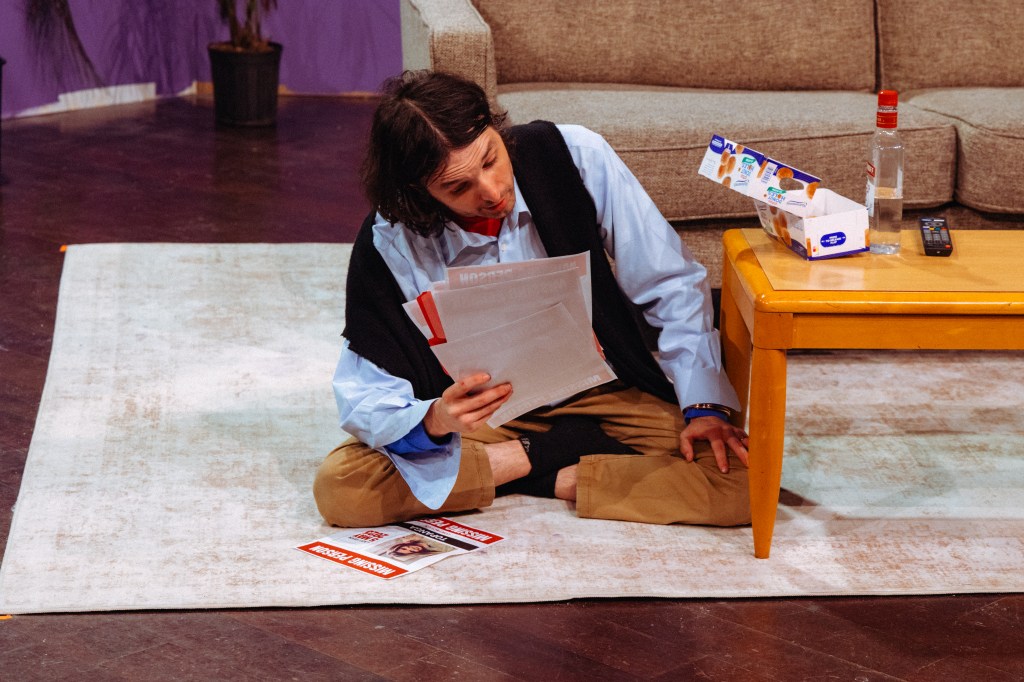
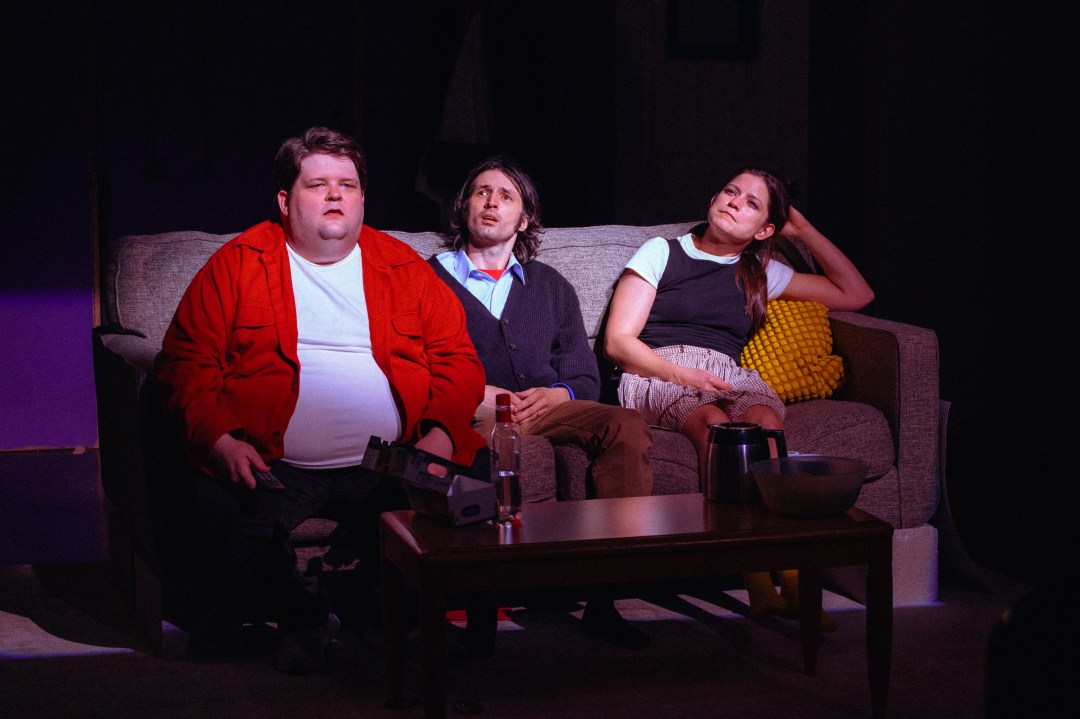
With the current state of our world, many members of society have taken to becoming firmly rooted in nostalgia. When the walls begin crumbling around us, what’s better than returning to the warmth and familiarity of something we love. With their latest production, Dirty Gold shows us what happens when that obsession goes a step too far, in Insomnia Cafe, a deeply uncomfortable, yet darkly funny, tale of two Friends-obsessed young people whose love for their favorite TV show leads them down dark paths. Written by Bre Bietz, Insomnia Cafe is a dark dive into the murkiest bits of the human psyche, creating the kind of “comedy” that makes you question just how dark of a joke you’re willing to laugh at.
Insomnia Cafe follows the story of two characters known only as “The Man” and the “The Woman”, whose devotion to NBC’s hit sitcom Friends has led them to a bizarre living situation, where they spend their days pretending to be the characters from the show. As the play begins, they’ve found their one missing piece: a man perfectly-suited to play the role of Chandler! Of course, this man has not come willingly, instead having been kidnapped from the cafe against his will, finding himself tied to a chair as the action begins. Over the following 80 minutes or so, these three characters dance a dangerous tango, with alliances, wills and minds being broken, until we find ourselves at an outrageous finale one must see to believe, doubling down on how even our most innocent obsessions can be our downfall.
One of the most impressive parts of Insomnia Cafe is how psychologically rich it is, while never losing focus. Many times while describing the play to someone, a person would tell me that the show must be complicated to follow, but it’s to Bre Bietz’s credit, as well as that of director Roy Lazorwitz, that the plot and/or ideas never get too labyrinthine. Even as motivations shift and turn, and big ideas of control, compulsion and fixation come to the fore, it remains a simple tale of three lost souls finding something missing in each other, for better or for (considerably) worse. Of the two shows I’ve seen from Dirty Gold, they’ve shown themselves to be a company that works hard to maintain a shared vision, and Insomnia Cafe is a great example of that spirit, as everyone involved gives their all to keep focus on the same goal.
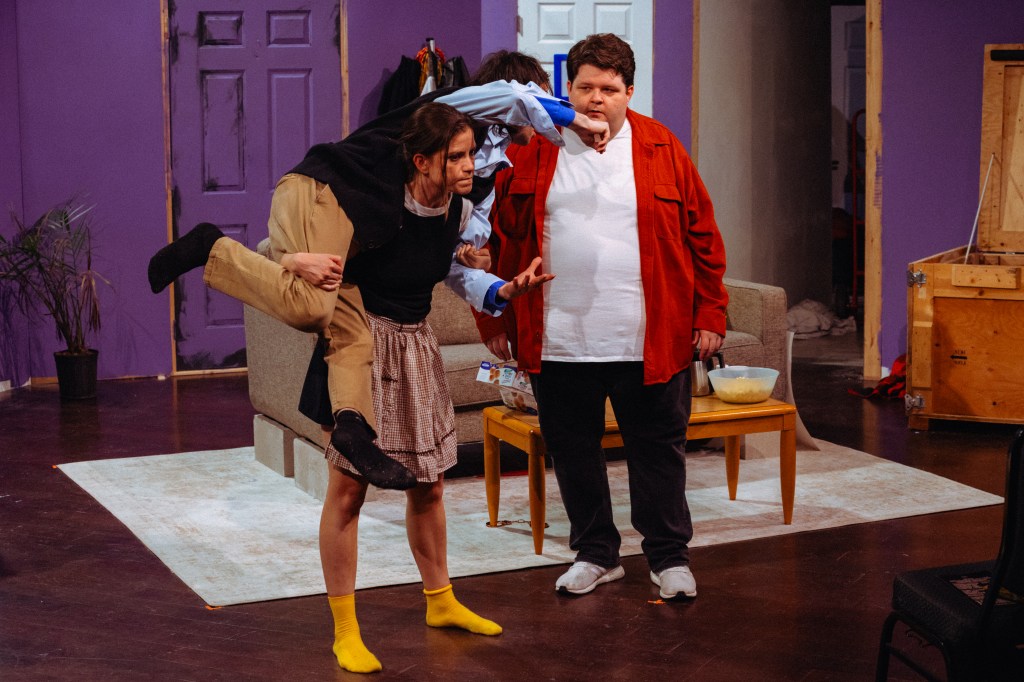
One clever trick Insomnia Cafe uses to introduce us to the world-state is by dropping the audience in at the same time as the play’s central victim, Dwyer. As he begins to piece his situation together, we discover these things alongside him, creating an excellent worldbuilding tool. It takes a steady hand to keep wits in this psychological maelstrom, and luckily Justin Smith has this steady hand, but it’s his ability to slowly crack that stolidness as the play progresses that’s truly impressive. Once the play reaches its explosive finale, and Dwyer finds himself very changed, we don’t feel the rug pull, because we’ve taken the progression right alongside him, and it’s to Smith’s credit that, for the most part, this transformation is a believable one, with him playing each moment of the victim-to-torturer journey with gusto.
The characters in Insomnia Cafe each take turns playing a character from Friends, meaning each one has to take on the personalities of more than one member of the show’s cast, and on no one’s head does this fall harder than Lena Long’s, who plays “The Woman”. Having to portray Phoebe, Monica, and Rachel all at once is a feat in-and-of itself, and it’s always entertaining watching her switch between these character, capturing each different one with something as simple as a change of vocal tone, or a facial expression. Sometimes we see her changing from moment to moment, manipulating the men around her by taking on the guise of a Monica or Rachel to get what she wants. Long really sings, however, when the sad, lonely girl underneath it all peeks through, and the truth of her unique situation comes to light. Much like Dwyer, she wasn’t always a willing participant in this charade, but, much like “The Man”, there’s some broken part of her deep down that she’s hoping this exercise will fix, even if that hope is built upon a crumbling foundation.
This play simply wouldn’t work without Kyle Romero’s towering performance as “The Man”. Romero looms large over the proceedings, a malevolent force twisting everything around him, but this is no hard-edged demon or remorseless psychopath. Indeed, some of the play’s best moments come when layers are peeled away (at one moment, literally), and the raw pain and trauma come to the forefront, as we begin to see what could turn a seemingly normal person down such a dark path. Romero is both horrifying presence and scared little boy all at once, with Romero bringing an emotional acuity to the role that’s quite remarkable, balancing the darker and more somber, sobering elements to create the portrait of a broken, bleeding thing trying to fix itself by breaking off parts of others. It’s a darkly fascinating performance, and one that will stick in my mind for some time.
Insomnia Cafe is a dark show, and one that requires at least a little bit of homework to truly connect with. I can’t imagine someone without a working knowledge of Friends navigating their way through the work, and even then, some of the roads the show journeys down may be too far for some sensitive viewers (though there isn’t anything too taboo on display, not to worry). If you are able to take the journey, what you find when you emerge at the end is a fascinating psychological allegory on the dangers of living in nostalgia, and dangerous places obsession can take one. Dirty Gold is showing itself to be a rambunctious young company, taking large swings, and in the process creating unique, challenging works with exciting young talent. Their energy and passion is an oft-needed shot in the arm, and one hopes they can keep this fiery momentum going into their next shows.