

Hamlet needs no introduction. It’s one of the canon’s most seminal works, given every transposition and permutation imaginable, from a version entirely in Klingon to one featuring wuxia-style kung-fu, so it’s easy to go into recent Pulitzer-Prize winner Fat Ham, the latest production by Austin Playhouse, with some trepidation. After all, the age old story of killed-father, revenge-fueled son, bloody-swordfight has been done to death, but writer James Ijames has taken the bones of Shakespeare play and created a modern examination of masculinity and queerness in contemporary society, especially in Black Society. Austin Playhouse has brought in a stellar team of actors, including both talented up-and-comers or seasoned professionals (including the triumphant return of Marc Pouhé to Austin stages), to create an experience that’s at turns heartbreaking, soul-lifting, and side-splitting.
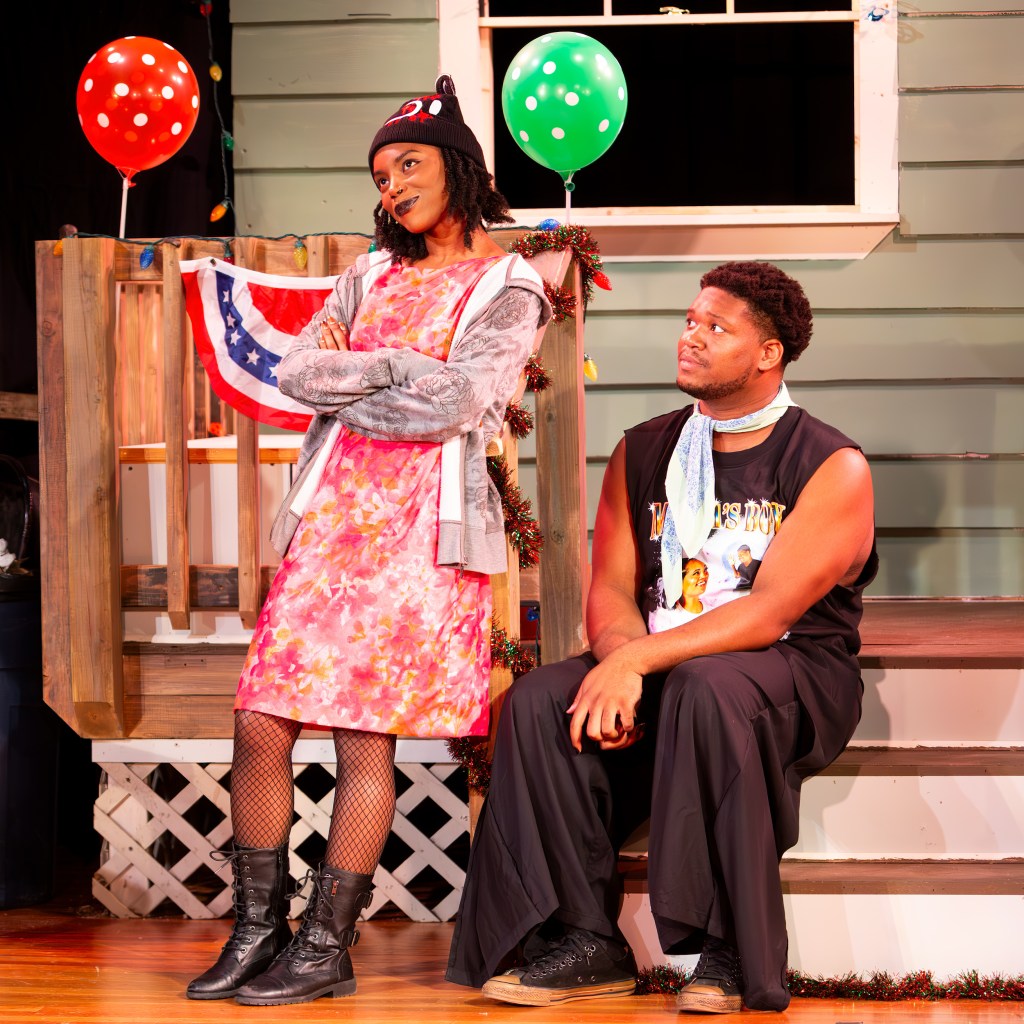
When we first meet our Hamlet, here named Juicy, he’s preparing his backyard for a barbecue in celebration of the recent marriage of his mother and uncle (the play does indeed bring up how weird this is, thankfully). Suddenly, he’s met by his father’s ghost (complete with long white sheet), who alerts his son to the malicious actions of his new stepfather. What follows is mostly the story you know: characters come and go, tensions rise, people die. But the true joys of Fat Ham lie in where it veers from the material to create moments of magic. Whether it’s touching relationship between Juicy and Larry, Fat Ham’s version of Laertes; the endearingly weird quirks of Vivian Noble’s Opal; or its joy-filled finale, Fat Ham will often zig where you expect it to zag, creating an experience that’s full of wonderful surprises.

Albert Igbinigie is a revelation here as our main character Juicy. A sensitive outsider in a world of Alpha Men, his world is a dangerous one. His Uncle Rev comes into his life like a pipe bomb, transforming his already uncomfortable world into one of dominance and violence, and Juicy shows how to meet that violence with a depth of feeling. Throughout, Igbinigie shows us how empathy and tenderness can be powerful weapons against oppressive toxic masculinity, his open vulnerability being both his curse and his power. Igbinigie’s willingness to present his softer sides to the audience shows a remarkable amount of courage for the actor, and that compassionate strength creates some of the play’s most touching moments, especially in its final third. The actor has quickly shot up my list of ones to watch, and I cannot wait to see where his uniquely brilliant talent will take him next.
Larry, this play’s version of Laertes, is a character that, on paper, encapsulates the very masculinity that Juicy is trying so hard to run from. He’s a celebrated military man with a tough outer shell, who talks little but gives off an impressive front. Through his performance, however, we see how toxic masculinity can harm even those who fall in line with it. Nicholas Hunter plays Larry as a man torn, forced to tamp down their true self in order to comply with society’s ideals, and that repression can be a difficult thing to portray. Indeed, in the beginning the character can feel a little one-note and buttoned-down, but as the play progresses, Hunter is able to bring forth the pain and hardship underneath everything, until he explodes in a breathtaking moment of passion.
It is an absolute delight to see Marc Pouhé back on stage here, and he comes back with a bang. Playing both Juicy’s slain father Pap, as well as the Uncle-cum-slayer Rev, Pouhé demands our attention whenever he’s on stage. Pouhé has always been actor with a unique blend of charisma and power, and here, as Rev, he weaponizes both to make a truly charming villain. So many times, it can be difficult to understand why other characters like, or even tolerate, Claudius or his stand-ins, as he can be played as cold, uncaring, even vicious. Pouhé’s Rev on the other hand is as charming as they come, a King of the Grill with looks that kill, and you can see in an instant why Juicy’s mother would be so charmed by him. The character is played with pure magnetism, and he creates the perfect foil to the reserved, more insecure Juicy, his maliciousness played like an all-too-realistic form of narcissism. The actor really shows his range here, however, in one of the show’s most subtly fantastic scenes, where, during a musical number, Pouhé shows off some of the absolute best non-verbal acting I’ve seen in some time, as Rev’s typical cool, slick mask slips away as the character puts on a look of sheer terror as he thinks his nefarious plans may have come to light. Pouhé’ gets to stretch even further through his performance as Pap, a typhoon of raw, emotive power, unleashing a torrent of aggression and anger, his direct forthrightness a delight balanced against Juicy’s more aloof guardedness. It’s the kind of panoramic display of talent that one could only get from a performer of Pouhé’s caliber, and the play is all the better for it.
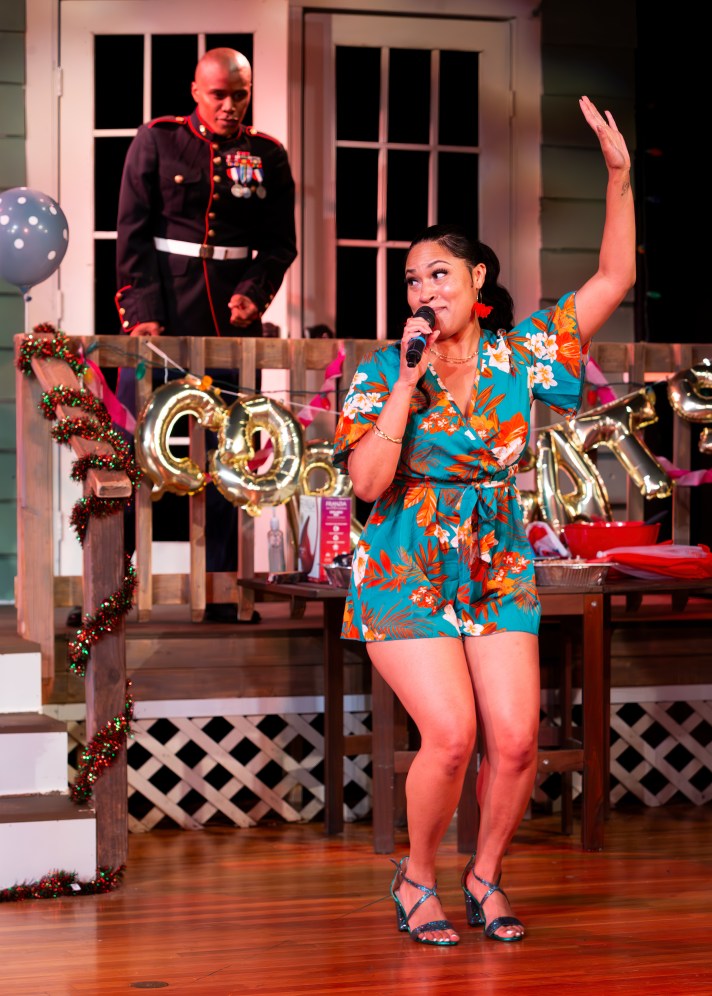
I could go on for another several hundred words about these performances and how well they play amongst each other, whether it’s Yunina Barbour-Payne’s explosion of of heart and ebullience as Juicy’s mother Tedra; the laidback stone coolness of Vivian Noble’s Opal; Gina Houston’s laugh-a-minute performance as Rabby, Opal’s mother and the buttoned-down, religion straight-woman to all the nonsense around her; or Addrian Shontai’s Tio, this play’s Horatio, the wisecracking life of the party responsible for many of the work’s biggest laughs. When these players all come together, it’s nothing short of magical, each little quirk and instability culminating in explosive moments of pure glee.
Fat Ham accomplishes a fascinating balancing act, showing reverence to Hamlet and its messaging while also playing on the audience’s expectations of the play, to amazing results. Those familiar with the story know where each of these decisions will lead our characters, so it’s a pleasant surprise when the play ends with an explosion of joy. Instead of simply following the plays beats, Fat Ham instead reminds us of Hamlet’s essential message, that the road to vengeance only leads to dead ends, and that it’s better to forgive and choose life, and joy.
In many ways, we live in a society where strength and hardness is celebrated. Men are often judged by how masculine they are, how well they build, protect, or fight. One of the central questions of Fat Ham is what if our softer sides could also be celebrated? A What if instead of violence and revenge, we instead choose love? Director Ben Wolfe and his talented cast and crew have created the perfect work for this moment, a celebration of the outsiders, the weirdos, those thought too sensitive, too loud, who take up too much space, who try to walk a path all their own. It’s the perfect piece to celebrate this Pride Month, raising up queer voices and showing how our softness can also be our strength.
Fat Ham is playing at Austin Playhouse through June 29th. For more information and to purchase tickets, visit austinplayhouse.com.
Photos courtesy of Steve Rogers Photography.

 AUSTIN ARTS WATCH