
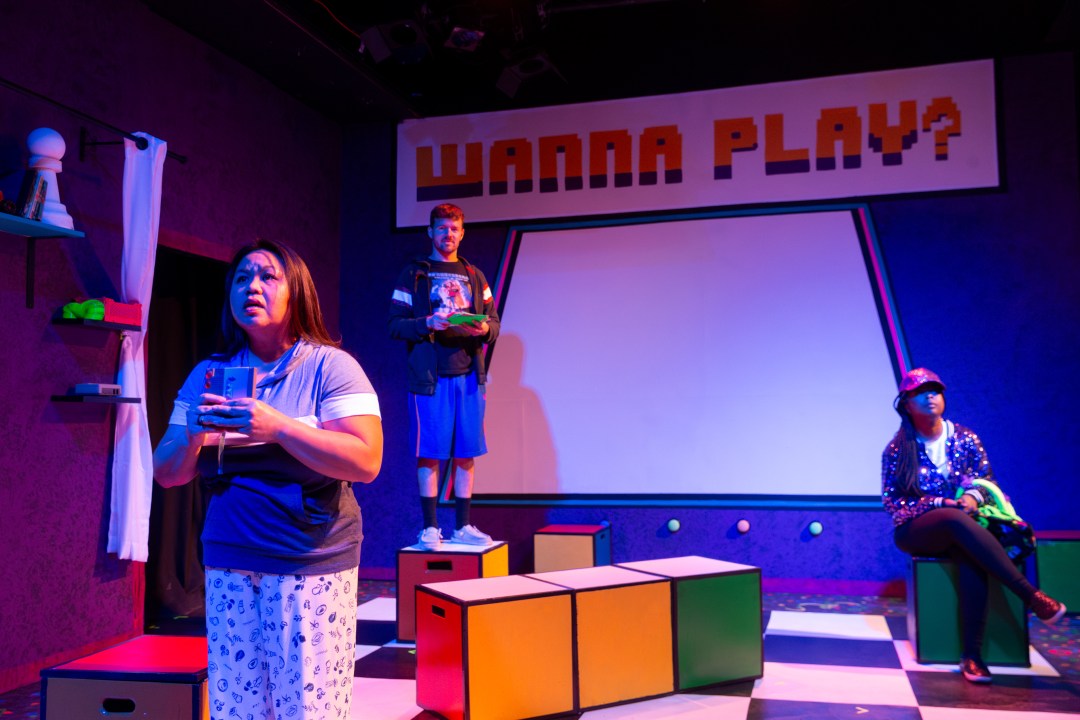
Online Communication in our modern world is a bit of a double-edged sword. The internet has enabled us to remain connected in ways earlier generations could never have imagined, allowing us to have satisfying relationships with people around the globe, to talk to the people we love anywhere, at any time, at a moment’s notice. At the same time, in many ways, it’s disconnected us from the outside world, in some cases weakening real life relationships to maintain our online selves. The internet has become a place to escape the terrors and hardships of the outside world, a place where we can forget our trauma and live as whatever versions of ourselves we like, though that leaves us with the question of what kind of side effects repressing these traumas may have. Its these questions that lie at the heart of Wanna Play, the latest from Color Arc productions, director Jamie Rogers, and writer Christine Hoang, a unique, heartbreaking fable tackling what happens when our online selves are forced to grapple with the outside world, and how personal connection may be a path to betterment.
We first find the protagonists of our story as their online avatars (played, in unique pixel animation, by Marc Pouhé, an artist I always enjoy seeing listed in a playbill), before we’re quickly zapped off to the world of The Here, a sort of live service game in which players are forced to go through a series of challenges before being allowed to leave for the real world. Here we find our protagonists in their real life forms, the pugnacious Gemma and the faint-hearted Ethan. Forced into a series of challenges by their game master, Capy (helped along with a touch of audience interaction), they must overcome the troubles of their pasts (some quite horrific), and learn the importance of honesty, intimacy and connection.
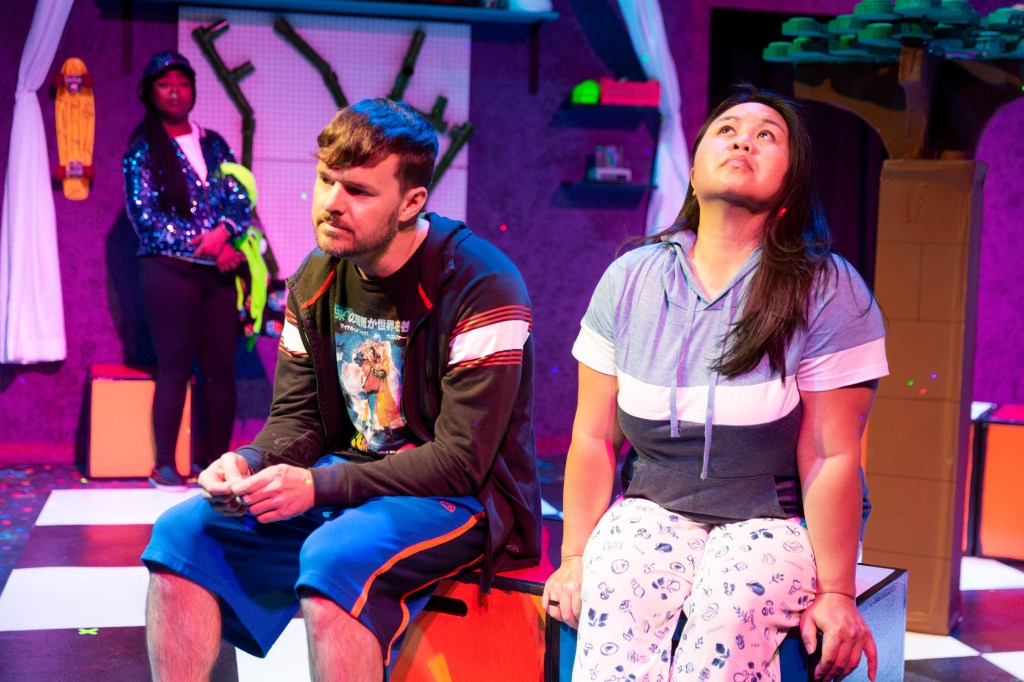
The trick Wanna Play plays on it audience is quite a good one. The basic set up, CB Feller and Liz Tyson’s set and property design, and even the manic capybara-themed Game Master, all paint the portrait of a bright, bubbly fun slice of 80s and 90s nostalgia, complete with glittery NES cartridges and marble tubes. Before you know it, however, the plays plunges its audience into the depths of human trauma, tackling everything from familial abuse to sexual assault. Though none of these are shown, the honest, raw description we get from the performers are nothing short of heart-wrenching.
Wanna Play feels like a very personal piece for Hoang, so it’s fitting that she cast herself to play one of the leads. Hoang’s Gemma is a lonely, jaded woman, whose years of parental disapproval and neglect have led to an isolated existence, without friends or connections, finding her only solace in the online world. Hoang isn’t afraid to put the rougher edges of her character on full display, not sugar-coating the character’s moments of aggression, rudeness, or snideness, playing them for the trauma responses they are. Gemma isn’t always a likable character, but for so many people who have lived with neglect or abuse, it’s a very relatable one. Watching how this character transforms throughout the show, in large part thanks to her growing friendship with fellow player Ethan, will surely act as a cathartic experience for many. Hoang provides the kind of frank, sincere performance that is unique, as if we’re seeing Hoang dissect herself before us, showing a courage rare in any kind of creative.
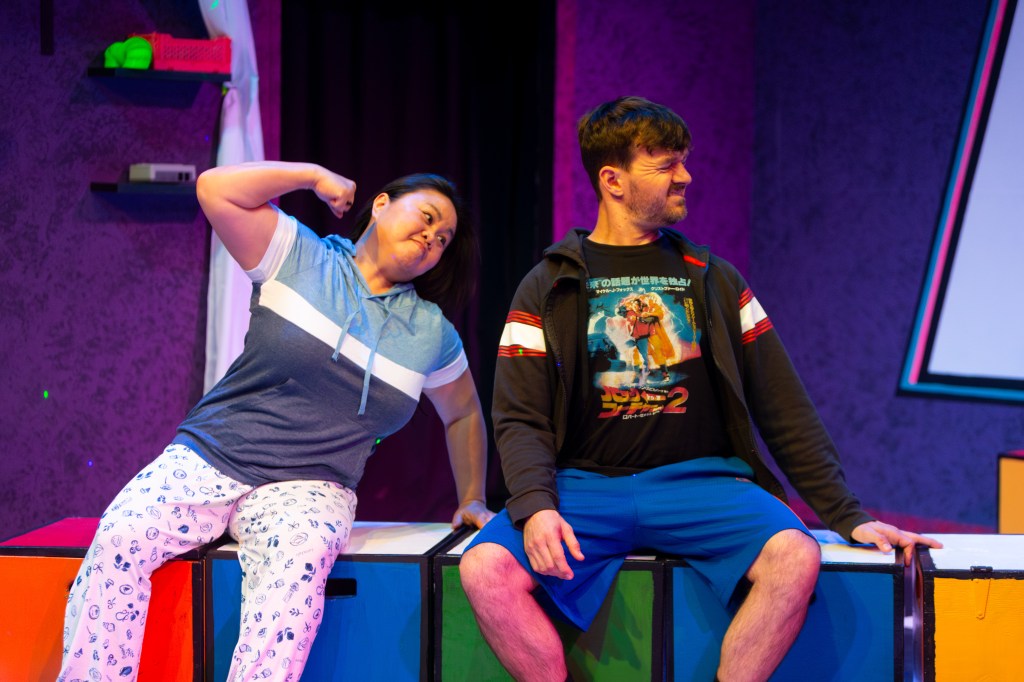
If Gemma shows us how jaded a life of neglect and isolation can make one, Travis Owens’ Ethan shows the other side of the coin. A life of abuse at the hands of his brother and father have led Ethan to become more withdrawn, timid, and sheltered, belittling himself in an attempt to maintain the few relationships he has left. Centering such a large part of your story on a character so timorous should be a challenge, but there’s something special in Owens’ quiet charm that helps make his character instantly likable, even when some of his weaker sides are on display. Once again, Ethan is not always the most pleasant character to follow, as his complete lack of self-confidence and his constant need for approval can become hard to watch. However there’s a tenderness and frailty to Owens’ performance as Ethan that makes him hard not to root for, and throughout the play, whenever we feel trouble might befall him, we can’t help but sympathize.
Don’t let my review thus far make you think Wanna Play is a dour experience. Sure, there are some truly crushing moments during the play’s runtime, but there are also plenty of moments of levity, typically revolving around the wonderfully manic performance of consummate highlight Michelle Alexander, who plays our game master Capy, the bright, fun MC who puts the other characters through the paces. While trying to remain neutral throughout, Capy puts our characters through the ringer with their games, trying to keep a light air to the proceedings while the subject matter turns darker. Alexander is always such a joy to find in a production, elevating any work she’s in with her boundless energy, and here is no exception, as from the moment she comes on stage, she brings with her an effortless cool and an infectious joie de vivre.
As someone who spent most of their life as an isolated people-pleaser, Wanna Play was often a difficult sit, as it exposed parts of myself that I wasn’t always ready to contemplate. The play is a raw nerve coated in cotton candy, trauma as transmitted through an arcade cabinet, but it’s also work of exceptional honesty, treating its troubled, damaged characters with real empathy and grace, and those are two things that all of us, in these troubled times, could use a little more of.
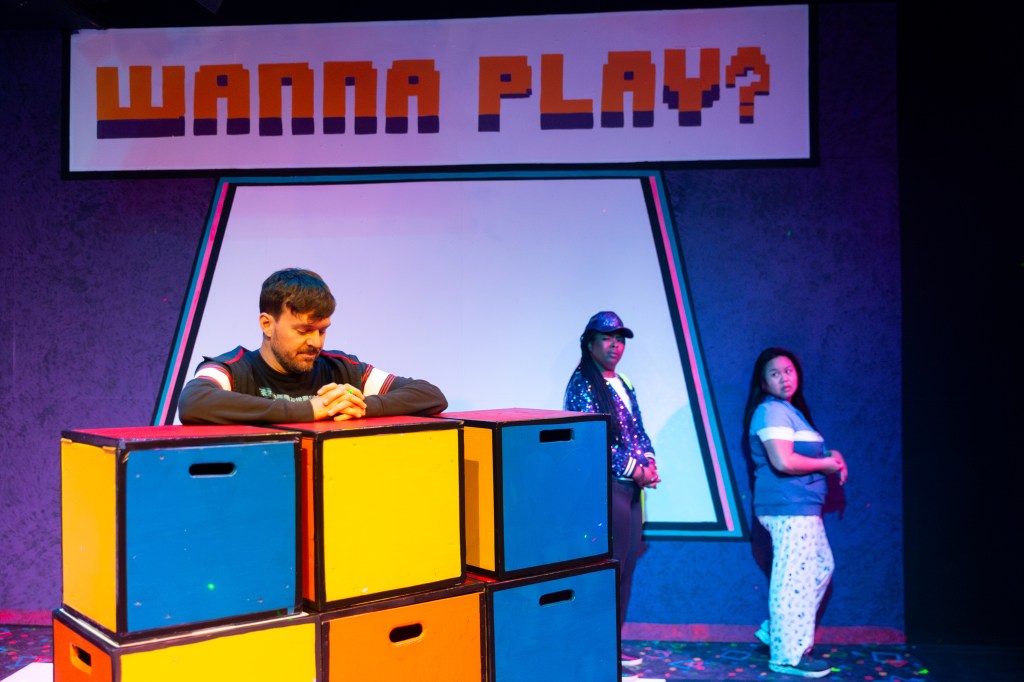
“Wanna Play” has a runtime of 90 minutes with no intermission, and is running at Hyde Park Theatre through April 19th. For more information, and to purchase tickets, please visit colorarcproductions.com.
Photos courtesy of Steve Rogers Photography.

 AUSTIN ARTS WATCH