

Having lived in Austin for nearly 40 years, it’s always a delight to see something written about my hometown. It’s become a rarity to see even local playwrights write specifically about the city, but She Was Here, the latest from local talent Raul Garza, now getting its World Premiere at Austin Playhouse, is a poignant portrait of not just Austin today, but of Austin throughout its history. Across four generations of Latinas, who all live at the same butter-colored house in heart of Austin, we’re shown the ever-changing face of our city as its culture morphs over the decades, and how our own personalities and worldviews change along with it. At the same time, we’re shown that no matter the changes, some things remain constant, no matter the time period: the lives, loves, and struggles between mothers and daughters, and our attempts to try to do right by ourselves and each other.
One of the real successes of She Was Here is its ability to capture the ever-changing nature of Austin, but also the continued resilience and strength of its people. The Austin of the 50s couldn’t be more different than that of the 70s, just modern day Austin is a far cry from what it was just 20 years ago. Despite these changes, the women we see throughout maintain similar strengths: they’re resilient, tenacious fighters willing to throw themselves into the world head first, despite the dangers. Each generation of women hovers as, at times literal, ghosts amongst their descendants, showing how the actions of those who raised and created us continue to influence us, even generations down the line. A rebuke in the past leads to revolution in the present; a gain in one generation leads to a loss in another. As the city changes and the people are shaped around it, so too are the people shaped by decisions made by their loved ones in the past, and one of the true wonders of Garza’s piece, given stunning life by Austin Playhouse’s production, is how it’s able to show this through the cascade of Latinas who grace the stage.
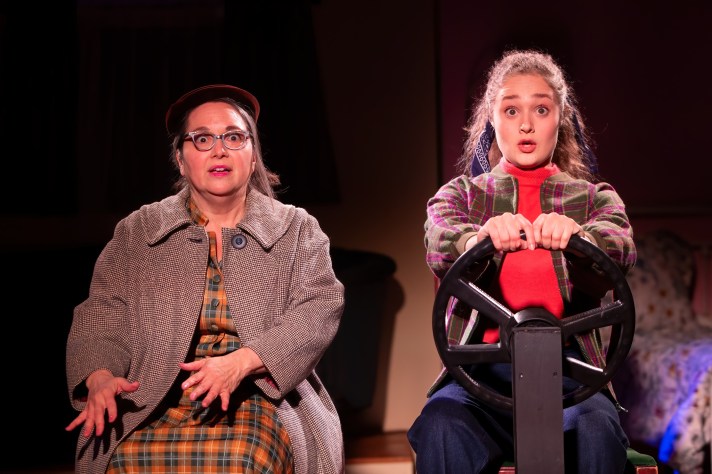
She Was Here is a challenging proposition for its actresses, as almost all of the performers here need to play at least two separate roles (in one case, three), and though these women are all latinas from the same family, they differ in rather significant ways. When Tonie Knight, who we first meet as 50s housewife Elsa, arrives in the second act as 1970s Mom Donna, it’s staggering to realize they’re played by the same actress. This carefree barfly of the 70s is such a far-cry from the buttoned-down 50s martinet that it can be shocking to adjust to the severe shift. Credit should be given to director Jerry Ruiz, costume designer Kelli Bland, and the rest of the creative team for creating costume, hairstyling, and makeup choices that aid in creating these unique individuals, but it’s Knight that truly impresses, being able to so embody two such radically different women, despite their demeanors and mannerisms being so completely alien from each other (though there is such joy in finding the ways in which one character may to bleed through into another at times).
Also handling a character transition well is Yesenia García Herrington, who plays both the adult Nicole in the 90s and Amanda, the last mother chronologically, in the COVID era. Though there are vast gulfs between the two characters, one a crusader for justice, who may have neglected certain elements of family life as she attempted to better the world; one a woman focused on being the best mother she can while balancing life during a quarantine, the one element that Herrington keeps steady is that they’re both attempting to be the best mothers they can. Both of Herrington’s roles are tricky, each having to balance a desire to do good for the world with trying to do her best at raising a daughter, with both over-correcting in major ways, so it’s to Herrington’s credit that she’s able to find the similarities in each character, even as she chooses unique aspects to bring out in each role.
Alyssa Hurtado plays out a similar transformation between three radically different sets of daughters: anxious 50s teen Donna, whose too-tight bridle will eventually lead her to become the carefree, negligent mother we see in the 70s; the smart, concerned revolutionary daughter Nicole of the 70s; and Annie, the all-too-real Gen X teen of the 90s, whose desire to learn about her past, even its darkest corners, helps to bring her mother back to her roots. The clear-eyed energy and brightness she brings to each of these roles is dazzling, even as she curves and splinters that light prismatically for each of the women. In Hurtado’s characters, we see that no matter how much the world changes, these headstrong, courageous daughters abide, even as the play shows us how the world, and the people that surround us, take their toll on those principles.
One doesn’t have to play several different characters to leave an impression, as is evident in Vivian Noble’s singular performance as Gabi. A child the modern era, the tail end of generations of strong latina women, she’s a revolutionary spirit shaped as much by the shadows of her ancestors as her own times, even as the world around her attempts to hold her down. Its another performance bursting with light and fire, as incendiary as it is illuminating, and the relationship she forms between Herrington as her mother feelings heartbreakingly honest.
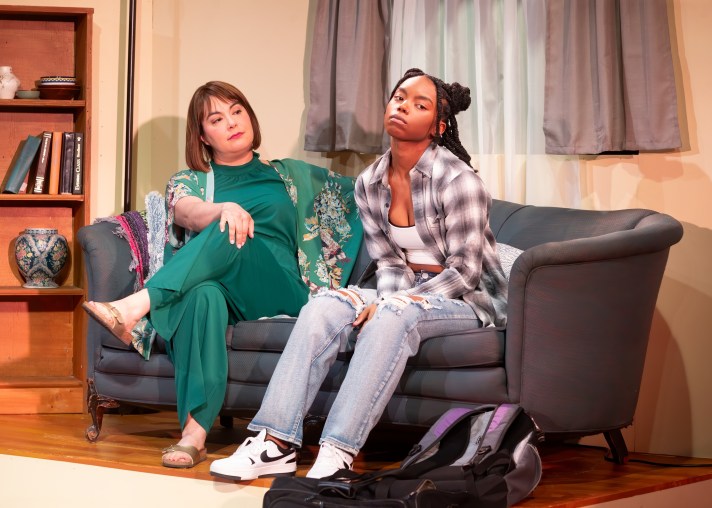
Raul Garza is quickly becoming a must-see writer, as his pieces seem to capture a sense of place and time in refreshing ways. With She Was Here, he’s created a fascinating patchwork picture of life in Austin, showing us that, even in a city with this many changes, the strong families that make up the city’s backbone remain a constant. It’s a piece with an authentically LatinX voice, that speaks of heritage and culture while still feeling universal, and Ruiz and his creative team takes Garza’s words and creates a world that feels so genuinely Austin. We’ve all met women like these; many of us have parents, aunts, sisters, or daughters just like these, and the portrait Garza and Austin Playhouse paint of these women and their struggle is like a warm hug after a long, hard day.
She Was Here is playing through February 9th, 2025 at the Austin Playhouse. For more information, and to purchase tickets, please visit austinplayhouse.com.
Photos courtesy of Steve Rogers Photography

 AUSTIN ARTS WATCH