
A curious feeling came over me as I left “Caught” the latest production of Hyde Park Theatre. Typically, when leaving a production, I have a general idea of the shape and character of a review, particular points I would bring up to give a reader an idea of what to expect from a work. “Caught”, however, left me in with a conundrum. Reviewing “Caught” in any typical manner would completely ruin the experience of watching “Caught”. “Caught” lives and dies by its form, by its shape, by its twists, and any surperfluous detail I mention here might take away from its wonder. Hell, knowing its a play kills a little of the experience, but it’s difficult to keep that particular cat in the bag. So, we’ll do this in parts.
If you’re reading this trying to figure out if you should go see “Caught”, you almost definitely should. It’s a demanding play, that asks one to bring an open, questioning mind, so if you’re looking for a relaxing, thoughtless evening of entertainment, this might not be the show. For everyone else, though, this puzzle box of a work is well worth your time. Ken Webster’s one of the few directors I’d trust to handle this behemoth, and his assistant director Mary Vo backs him up well; Mark Pickell’s sets are cleverly built and beautiful; Rebecca Robinson’s never been better, bringing her sensitive intensity to a set of performances that would be demanding on any actor; Robert Pierson is hilarious, as always, making the most of his limited time on stage; and this couldn’t be a greater introduction for most audiences to Norman Tran and Esther Park who each take on some difficult roles with aplomb. If you plan on seeing “Caught”, I would advise you to stop here, as learning much more might hinder the experience. Everyone else, lets dive a little deeper.
One of the fascinating things about “Caught” is that its a work constantly in conversation with not only the viewer, but also with itself. With each scene, each act, each change in location and character, we’re seeing another face of it, another sharp corner in this ever twisting box. At times the play feels more like something from Brecht or Artaud than anything more modern, as it demands its audience question the validity or reality of everything they’re seeing, questioning honesty in storytelling, and where experience, appropriation and truth begin and end. It’s a heavy work, and one that probably would require more than one viewing to truly grasp, but even then it would probably leave a viewer with more questions than answers. Then again, when does life ever give one easy answers?
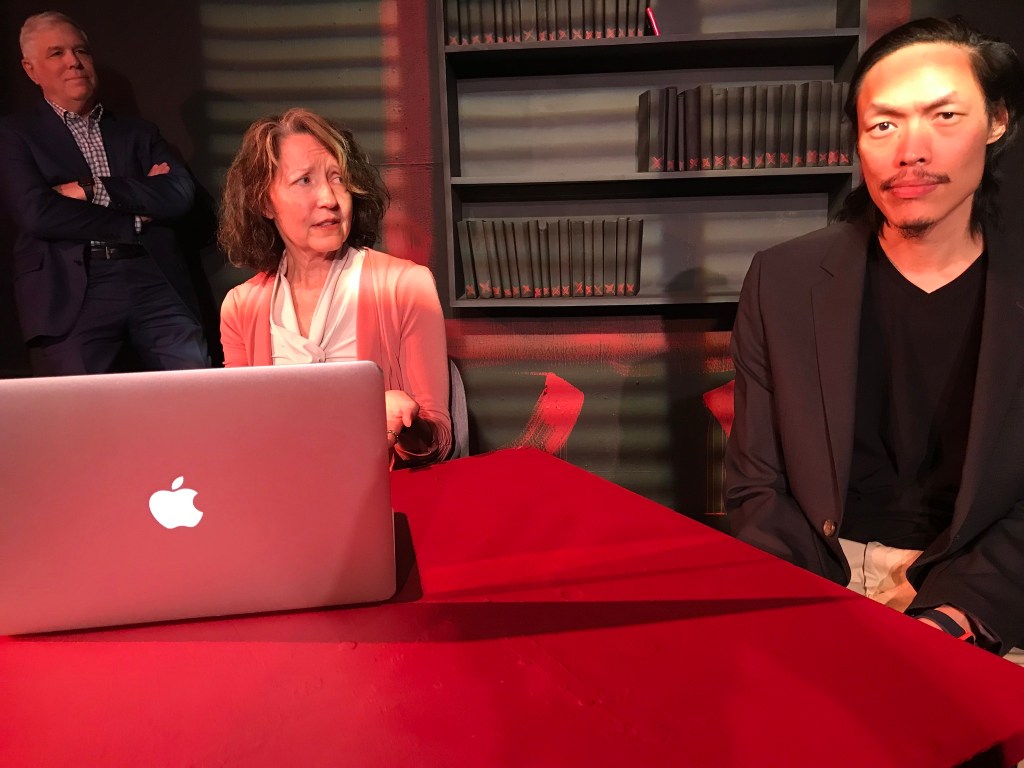
Throughout the course of the play, “Caught” is challenging our understanding of what we’re seeing. Our lens is subverted constantly, with actors changing roles, and even identities, so that the pieces don’t fully come together until the final bows are taken (and you’re never quite sure which bows are the final ones), and even then the audience is left off balance. This leads to some difficult work for the actors, as they not only have to embody these characters, but also the many facets of each, and its a testament to the absolutely astounding talent of these performers that the piece comes together as well as it does.
With her combination of effortless charm and honest intensity, Rebecca Robinson has been delighting Austinites with her work for years, so it’s truly an accomplishment to say that this may be her best work. Her ability to create instant chemistry with other actors is on full display, as the verisimilitude of her relationships is never in doubt, even when the about-faces begin and masks slip away like bushes in a mudslide, and her comedic timing with Pierson is one of the show’s real highlights. What truly impresses, however, is the building tension she brings in the second act of the play. The second act changes the entire world of “Caught” in some rather intriguing ways, and demands quite a bit from Robinson, as she takes on a character who, on paper, may appear simple, but in practice must have been agonizing. Throughout the scene, the character is forced into a more and more precarious corner, and the way Robinson takes on the growing pressure is nothing short of breathtaking, and when she finally comes to her breaking point near act’s end, her confidence and physical abandon is jaw-dropping.
The true shining lights here, though, are Norman Tran and Esther Park, the two enigmatic figures at the heart of the piece. They are both playing characters who inherently must hide things from the audience, or at the very least cast shades of doubt in their minds, which can be a difficult needle to thread, so it’s to their credit that they’re able to tackle the job with such panache. Tran in particular has a taxing job, as he carries most of the first portion of the play on his back, in one particular scene having to slowly peel away the mask of his personality until something entirely shocking and new remains. Its a difficult transition, but the slight, almost inperciptable changes he makes throughout the scene are intelligently and confidenly applied, reshaping the moments that came before. Park is left with a much different weight to bear, as we don’t necessarily doubt her motives, but she takes us on a journey to examine what truth really is, and the importance of said truth in art. It’s dense, powerful material, and in the wrong hands would seem overwhelming, but Park brings a warmth to the performance that helps to lighten the scene, which is refreshing in a play this intellectually rigorous. When she finally gets to share a scene with Tran in the final act, the chemistry feels simple, as the two seem like instant old friends the moment they sit down together. One hopes the two have a lot of wonderful work ahead of them, as here they’ve created an excellent calling card for themselves.
To say “Caught” is a mentally challenging play is an understatement. It demands a lot of its audience, and without a tight hold on the reins, the would go running out of the theater leaving its audience in a confused stupor, but Webster and Vo hold firm the more aqueous corners of the play, and our performers bring such stellar work, so that though our footing may sometimes seem unclear, we very rarely feel lost in the woods. It’s a puzzlebox to be sure, but one that obviously has a solution, and even if a viewer can’t quite reach that solution (Lord knows this critic didn’t), it’s still a hell of a journey.
“Caught” is playing at Hyde Park Theatre through September 23rd. For more information, and to purchase tickets, please visit hydeparktheatre.org.
Photos courtesy of Pearson Kashlak and Hyde Park Theatre.

 AUSTIN ARTS WATCH